What we doWhere we came fromHow we workPeregrineThe recordFive situations
Why Gray Matter Logic

Gray Matter Logic is an ERP consulting and implementation firm.

We implement and support Odoo, IFS, and Acumatica for manufacturers, aerospace and defense suppliers, construction firms, utilities, and food and beverage companies in the United States, Canada, and Mexico. We have delivered ERP since 2012, first as Ursa Information Systems, then as Open Source Integrators, and as Gray Matter Logic since May 2026 following the acquisition of Pragmatek. In January 2013 we became the first Gold Partner for OpenERP, now Odoo, in the United States and Canada.

Before we configure anything, we build a working model of how your business actually runs. The software comes after that, and it comes second on purpose.

Book a discovery call
Platforms

Three platforms, delivered in-house.

These are the vendors we know best. We are certified on all three, and we staff each practice with our own consultants.

Gold partner, and the first Gold partner in the United States and Canada, January 2013. Odoo publishes our customer satisfaction at 100% across 152 references, 68 in manufacturing. 46 certified experts, 31 on Odoo 19.

Named Odoo Best Partner for North America in 2019.

Delivered in North America since 2018, more than 20 implementations, carrying a practice that has been doing this work for over thirty years.

7 gigawatts of renewable infrastructure run on one of our builds.

Our newest practice. Current footprint is municipal and government work.

A young practice, growing deliberately.

The Odoo figures link to Odoo’s own partner directory. Their numbers, not ours.

The firm, in brief
2010
Incorporated. Delivering ERP since 2012.
Veteran-owned
And independent. No software publisher owns any part of this firm.
31
Published case studies, 21 naming the customer.
ITAR
Experience and cleared personnel.
What we actually do

Most ERP projects begin by asking which modules to switch on. That question arrives far too early, and answering it early is how you end up changing the business to suit the software.

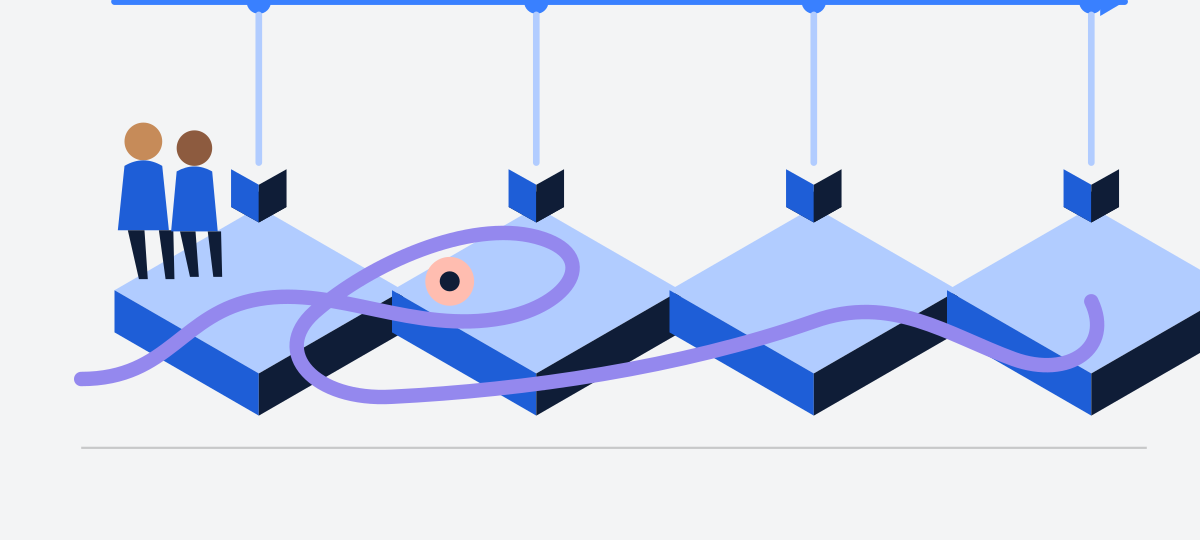
We start somewhere else. We build a complete model of the operation first: how work moves, where it stalls, which decisions get made and on what information, and where the friction between two departments is really a process that was never designed. Greg calls it high tech anthropology, and the description is more literal than it sounds. Half of what determines whether an ERP works is the part nobody writes down, including who trusts whose numbers and which workaround has quietly become the actual process.

That model is the thing we build the system from. It is also why we can say what an ERP could be for your business specifically. What it turned out to be for somebody else is not evidence about yours.

“The ERP should be a communication platform, not a control platform.”Greg Mader, President and CEO
Illustration: a documented process runs as a straight line across four department platforms while the real work doubles back through them as a tangled route

Two consequences follow. The first is speed. Nobody wants to sign up for an eighteen month implementation anymore, and the fastest way to shorten one is to stop discovering things in month nine. The second is that what gets built ends up shaped like your company, because the model it came from was yours. Industry templates start from somebody else’s.

Where this firm came from

Greg Mader was nine the first time he helped run an operation.

“My grandparents ran a low-voltage electrical contracting and manufacturing shop, and I did whatever a nine-year-old could do, which honestly wasn’t much. I was terrible at keeping the inventory clipboards up to date, better at shipping and receiving paperwork, and passable at following a board diagram to stuff and solder components where they belonged.”Greg Mader, President and CEO

He built the firm around something that shop taught him, which is that most people who install business systems have never had to run one. They know the screen. They have not stood at a receiving door at 4:45 on a Friday with a truck waiting and a part number that matches nothing in the system. So the rule here has always been that somebody on the project understands the work before anybody touches a configuration screen.

Odoo was called OpenERP when we bet on it. We took the partnership in 2012 and were the first Gold partner in the United States and Canada by January 2013, one of twenty-five in the world at the time.

The other half of this firm came from Minneapolis. Pragmatek was founded in 1991, spent its early years in SAP and business optimization, and moved into IFS in the mid 2010s. Its consultants spent decades inside supply chains at Toro, Snap-on, Tennant and MTS Systems, finding money in how work flowed, whatever software happened to be running. Most of them have been doing this for over twenty years. We acquired Pragmatek in 2024, and that practice is where our IFS bench came from.

The name is three months old. Nothing behind it is.

How we work

Software on a bad process just makes the bad process run faster. Greg has been saying that for years, and most implementations go straight to configuration anyway, because configuration is the only tool the implementer owns.

01  ANALYZE

We build the operational model. Documents, existing system configurations, the finance close, days on the floor and in the warehouse with your functional leads.

02  OPTIMIZE

Broken processes get fixed while they are still on paper and fixing them is cheap.

03  AUTOMATE

The software gets configured now, against the design you already agreed to.

04  TRANSITION

We build your team’s ability to run the system while we are building the system.

On the three platforms

We deliver Odoo, IFS and Acumatica, staffed with our own consultants on each, and almost everybody arrives with the platform already chosen. Odoo is where we are deepest and the directory numbers are the evidence. IFS is where the enterprise and asset-intensive work sits, carried by the Pragmatek practice. Acumatica is our newest and its footprint today is municipal and government work, which you should hear from us now while it can still change your mind about us. No software publisher owns any part of this firm, and nothing we earn depends on how many licenses you buy.

See how the Implementation Blueprint works →
Peregrine

How the operational model gets built.

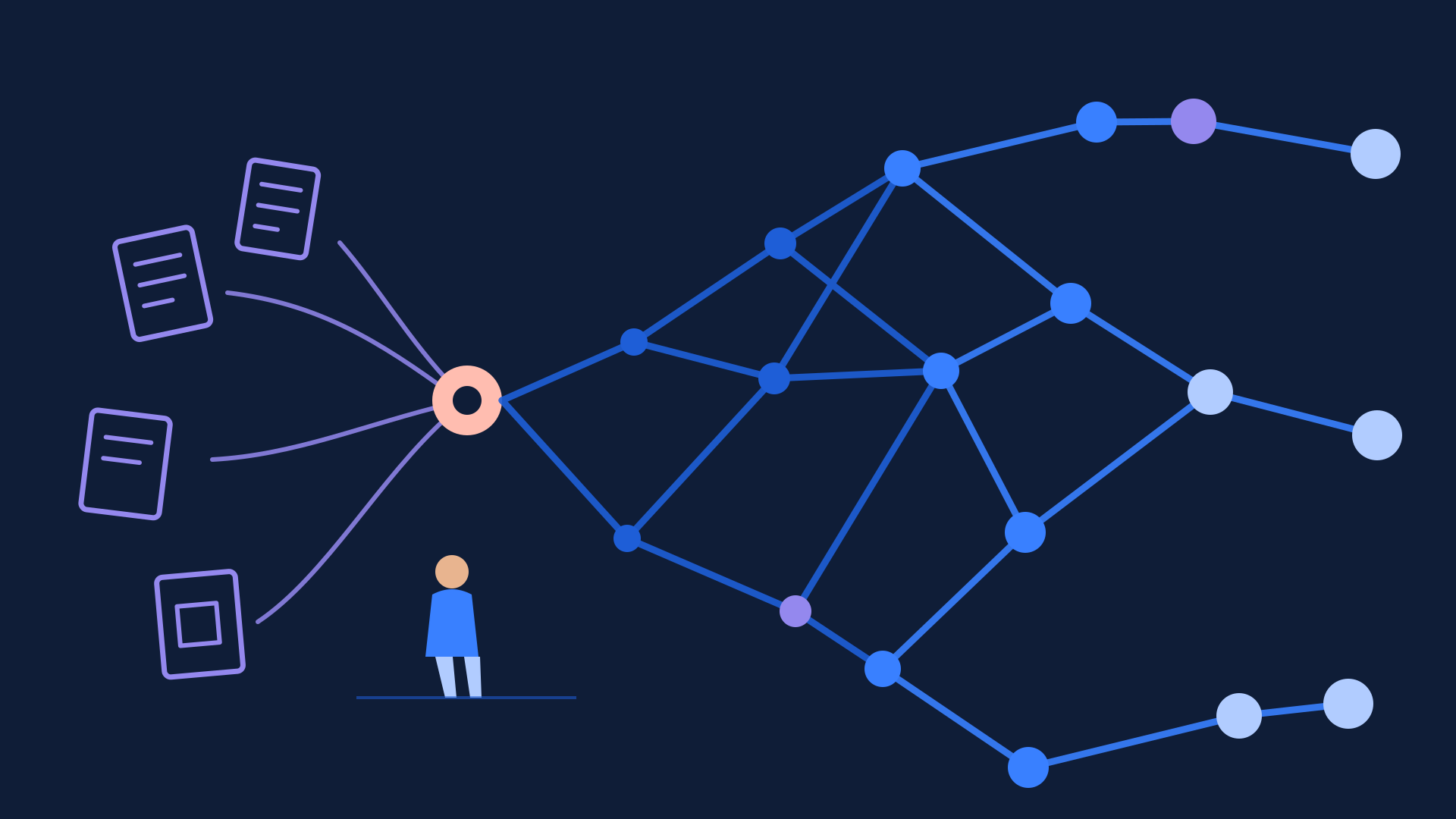
Peregrine starts working during the first pre-sales conversations, reading what already exists: documents, memos, diagrams, the configuration of the systems you are running now. By the time our consultants walk in, they understand the business. It keeps capturing through the whole life of the project, so the model grows as the work goes on. Nothing gets rebuilt from scratch at each phase.

Illustration: scattered documents and diagrams pass through a single capture point and become an ordered, growing lattice of connected nodes

Underneath it are four things. A harness that runs AI work across requirements, configuration and deployment on all three platforms. A knowledge graph assembled from finished engagements, holding what worked, what broke, and the situational detail that normally walks out the door with a departing consultant. Models we trained on our own coding standards and platform configurations. And frontier models where those are genuinely the right tool, used so that neither our knowledge nor your data ends up in a provider’s training set.

AI here supercharges experienced people. It does not replace them, and the time it frees goes into the parts of an implementation that were always the hard parts.

You will also see it working before you buy anything. Peregrine is on the call from the first conversation and it takes the notes, disclosed at the start, visible to you. In the Blueprint session we demonstrate it properly, against your operation and your questions.

It is most mature on Odoo and we are adapting it for IFS.

Who actually does the work

Every consultant on your project is our employee.

That sentence is doing more work than it looks like it is. A large part of this industry sells you a senior team and then routes the build to a development centre on another continent once the statement of work is signed, so the people who scoped the project are not the people who deliver it, and the distance shows up as rework. We do not subcontract delivery and we do not run a separate offshore build shop.

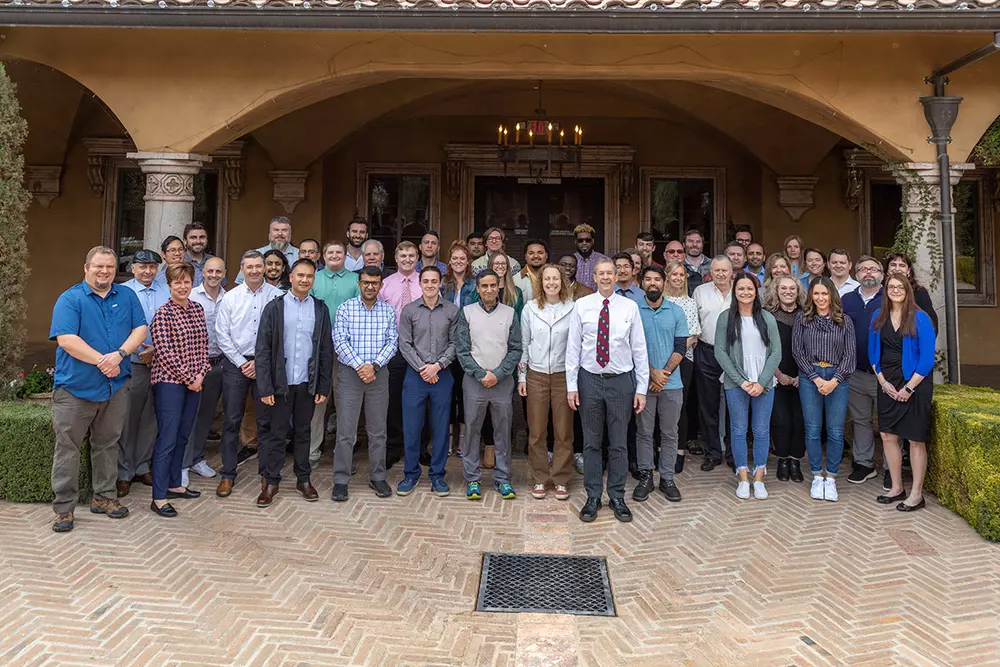
The Gray Matter Logic teamA consultant mapping a process by hand during discoveryWorking through a design on the glass wall

The people who scope your project are the people who build it.

Our people work from the United States, Canada and Mexico. They come to your site. They walk the production line, sit through a month-end close, and stand at the receiving door during a shift, because the model we build depends on watching how the work is actually done. You cannot get that from a requirements questionnaire, and you cannot get it at a twelve hour time difference.

Field service

Field service is where an ERP either reaches the people doing the work or quietly stops at the office door.

We wrote our own platform for it on Odoo. Open FSM covers dispatch tied into the helpdesk, work orders, demand and capacity planning, parts and equipment traced from vendor to warehouse to the customer's shelf, contracts with entitlements, real-time mobile status for technicians, and automated billing with invoice-exception handling. Because it runs inside Odoo, field operations and the ERP share one system of record. Twenty of those modules went back to the open source community, the pattern that keeps custom work upgradeable. Done properly it moves field technician efficiency by roughly a fifth.

The industry keeps piling optimization onto field service software, and algorithms are good at producing a baseline schedule. Then the real day arrives: traffic, weather, shifting priorities, a customer who is not there. One of our field service advisors watched route planners at a California utility with 1,200 technicians manually rework nearly every algorithm-planned route. So we build for the people handling the exceptions, with fast communication between office and field and optimization in a supporting role. AI supercharges experienced dispatchers; it does not replace them.

CIO Review named us one of its most promising field service solution providers for 2021. On the IFS side, the Pragmatek practice brought its own field service depth, which is why we can have this conversation on either platform.

What happens at cutover, and after

Everything above describes the part of the relationship that happens before you sign. Your real question is about month seven.

Cutover is phased

We rarely move a whole business in one night. A defense and aviation electronics manufacturer went live on IFS in ten months, UK operations first at the start of a fiscal year, US operations the quarter after. Pavlov Media ran a small first phase that paid for itself in four to six months, then took another eighteen to twenty-four months for the rest. Progressive Sealing replaced decades of legacy systems without stopping production. Which of your sites moves first gets scoped before anything is built.

After go-live, three programs, each priced on its own

A support desk with tiered coverage hours and response speed, written into your agreement. Systems management, where we administer the ERP at whatever depth you want, available whether or not we host it. And infrastructure hosting and monitoring for environments we operate, which you will not need if you are on IFS Cloud, Acumatica SaaS, Odoo Online or Odoo.sh, because the publisher runs those. Development, later migrations, training and audit support are priced when you use them. On compliance, the cloud providers hold the certifications; we configure to them and stand with you through the audit.

You can also go around us

Ask our customers what it was actually like six months after go-live and we will hand you the phone numbers.

The record

Two kinds of work sit here. Some are ERP implementations. The others are operations and supply chain consulting, where the money came out of redesigning how work flowed and any software involved already belonged to the customer.

The Toro Company
Fortune 500 · NYSE: TTC

$162 million in supply chain savings over three years and a 37-day improvement in the cash-to-cash cycle. Program and operations work across a supply chain and an SAP estate Toro already had. No ERP was implemented.

Snap-on Incorporated
S&P 500 · NYSE: SNA

$49 million in combined savings across transportation, sourcing and logistics, from a program office running 2003 to 2013. Earnings per share grew fourfold over that decade, checkable in their SEC filings, with the supply chain program one contributor among several.

Tennant Company
NYSE: TNC

$5.2 million average annual net income increase and a 20% improvement in revenue per employee.

“Gray Matter Logic brought a seasoned team of professionals that delivered outstanding bottom-line results.”Tom Paulson, Chief Financial Officer, Tennant Company
A defense and aviation electronics manufacturer
IFS · customer anonymized at their request

Plants in the US and UK unified on IFS in a ten-month go-live. The UK operation had no ERP at all beforehand. Month-end close went from weeks to days, MRP that had been a multi-day exercise in spreadsheets and email started running in minutes, and aviation regulatory compliance now lives inside the core system.

Progressive Sealing
Odoo · discrete manufacturing

Decades of unintegrated systems replaced across sales, purchasing, accounting and manufacturing, deployed without stopping production.

“We now have one version of the truth. It’s eliminated confusion, saving us precious time and resources.”Nick Burdick, CIO, Progressive Sealing
Proslat
Odoo · migration off NetSuite

Sixty days from start to go-live on January 1, mid holiday season, with more than 100 customizations and live EDI links to Home Depot, Costco, Canadian Tire and Amazon. No sales lost during the cutover.

“Other businesses we know of lost 10% of their sales during system migrations. Proslat didn’t lose a dollar of sales.”Michael Presseau, Vice President of Operations, Proslat
Blue Ridge Power
IFS Cloud · construction and renewable energy

More than 7 gigawatts of infrastructure deployed nationwide, running on one platform, with full project visibility and real-time margin tracking. Multi-state tax compliance stopped being a manual job.

Pavlov Media
Odoo and OpenFSM · telecom across 40-plus states

Phase 1 paid for itself in four to six months. Twenty field service modules built and contributed back to the open source community.

Thirty-one studies are published in full, 21 naming the customer and 10 anonymized at their request. Every metric on our results page carries a source attribution telling you whether it was independently verified, publisher-confirmed or self-reported.

Read the case study from your industry

Five situations bring companies here

If you are early, the useful next step is not a proposal.

It is a conversation about how your operation actually runs, which is the same thing our projects start with.

Book a discovery call

Last reviewed: 2 August 2026